
Why Do We Clash Even When We Have The Same Goals?
From Positions to Interests: How Leaders Overcome Conflict

If you’ve spent any time in a team meeting, a family discussion, or a public debate lately, you’ve probably noticed something troubling: people arguing fiercely even when, deep down, they’re aiming for the same outcome. You can feel the tension rising, the conversation tightening, and the common ground fading; even though the underlying goals aren’t actually that far apart.
What’s happening in moments like these isn’t a failure of intelligence or goodwill. It’s a failure of visibility. We focus on our positions: the immediate solutions we cling to, defend, and project; and overlook our interests: the actual objectives we care about that could actually connect us.
This week’s article explores why that happens, why it’s so hard to see, and what leaders can do to uncover the interests that move people from friction to alignment.
I’d also recommend listening to this episode of Humanity At Scale: Redefining Leadership Podcast: From Conflict To Connection: Harnessing Curiosity, Empathy, and Dialogue. Dr. Tania Israel, Associate Dean for Diversity, Equity, and Inclusion at UC Santa Barbara and award-winning author, explores how leaders can bridge divides and foster human-centered workplaces.
I hope you enjoy this edition. If you do, I’d love for you to subscribe and share it with others who might benefit. Let’s dive in.
🔥 SPARK OF THE WEEK
AI won’t replace trust, purpose, and values, but it will expose the absence of them.
AI accelerates everything: decisions, patterns, consequences. And when speed goes up, the truth shows up. Thin trust becomes hesitation. Vague purpose becomes drift. Performative values become misalignment. AI doesn’t create these gaps; it simply makes them impossible to hide.
👉 Read: Leadership Redefined: Trust, Empathy, Culture, and Purpose in the Age of AI
From Positions to Interests: How Leaders Overcome Conflict
We’re living in a moment when disagreement feels louder, sharper, and more personal than ever.
You can see it in politics, in our communities, and increasingly inside organizations. Conversations that should be about solving problems quickly become battles over who’s right. People dig in. They defend their views. And the louder the world gets, the more tightly we hold onto our positions.
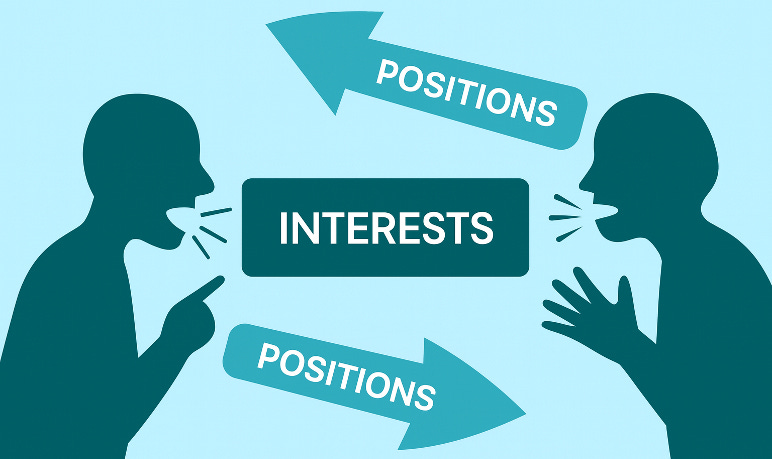
Yet what’s striking is how rarely the visible argument reflects the real issue. Most people argue from the surface—what they want—while the real tension lives underneath: concerns about risk, hopes for recognition, fears of losing influence, or a need for clarity in an unpredictable environment. We fight over positions, but we connect around interests.
That distinction explains why so many conversations break down. We talk past each other at the level of solutions instead of pausing long enough to understand the motivations shaping those solutions. Leaders who learn to shift the conversation downward, from what’s being said to why it’s being said, create the conditions for alignment, trust, and common ground.
The Core Distinction: Interests vs. Positions
Negotiation research has shown for decades that conversations break down when people argue only at the level of their positions. Roger Fisher and William Ury’s foundational work made this clear: positions are the specific solutions we put on the table, while interests are the motivations, needs, fears, and aspirations that explain why those solutions matter. The power comes from seeing the difference; not academically, but in the real-life moments when tension shows up.
And when you look closely, the contrast becomes easy to recognize.
Clarity vs. complexity. A position like “The deadline has to be Friday” offers clarity: a crisp, simple answer that cuts through ambiguity. But the complexity underneath involves a mix of interests: protecting downstream work, avoiding a slip in credibility, or managing a commitment someone made under pressure. The firm date is the visible shortcut for a much more tangled reality.
Rigidity vs. flexibility. A position such as “We need stricter gun laws” or “We can’t restrict gun rights” creates rigidity: a hard line that forces the issue into an all-or-nothing frame. The flexibility lies in the interests beneath it: wanting children to feel safe at school, wanting families to feel secure at home, wanting fewer tragedies in communities. These underlying concerns open far more avenues than the rigid stance suggests.
Surface logic vs. human logic. A position like “Teenagers should not be allowed on social media” reflects surface logic: a straightforward rule meant to eliminate risk. The human logic underneath is shaped by deeper concerns: fear of online harassment, worries about mental health, or a desire to shield kids from pressures they themselves struggled with. The simple rule is just the expression of a very human set of worries.
Opposition vs. alignment. Positions such as “let’s ban abortion” or “women should make their own decisions on abortion” creates opposition: clear sides, clear labels, and an assumption of incompatible worldviews. Yet the alignment beneath these positions often includes shared human interests: autonomy, dignity, safety, moral responsibility, and concern for people facing difficult circumstances. The label obscures the common ground.
Identity defense vs. purpose discovery. A position like “This is my call, this is how we’re doing it” shows identity defense: protecting authority, credibility, or reputation. But the purpose underneath usually points to something broader: wanting consistency for the team, avoiding confusion, or preventing missteps that could hurt customers or colleagues. The shield of authority hides the shared purpose driving the stance.
Positional Dynamics Stymie Organizations
Once you understand the difference between positions and interests, it becomes clear why so many organizations get stuck at the surface level. Work environments are full of deadlines, shifting priorities, unclear expectations, and political currents that push people toward fast, defendable positions instead of the deeper interests that actually move conversations forward. The patterns show up everywhere:
People rush to solutions. Under tight timelines or heightened scrutiny, employees default to positions like “We just need to finish this by Friday,” even though the real interests involve protecting credibility, avoiding yet another cycle of churn, or shielding an overextended team from more stress.
Teams get territorial. When roles or decision rights are fuzzy, people cling to positions—defending a scope, a process, or a piece of turf—because their underlying interests are about maintaining stability, influence, or simply not being sidelined.
Leaders posture. In organizations that reward decisiveness and speed, leaders take firm positions to signal confidence, even when their true interests center on shared success, thoughtful trade-offs, or reducing long-term risk.
Meetings get stuck. Teams argue about tactics, budgets, or sequencing, while the real interests—different views of the stakes, mismatched risk tolerance, or competing definitions of “good”—remain unspoken and unresolved.
Assumptions fill the vacuum. When interests stay hidden, people interpret positions as intention: “He’s blocking me,” “She’s being difficult.” The stance becomes a story, and the human motivations beneath it go unseen.
The Neuroscience Behind the Standoff
These patterns aren’t signs of bad intentions or weak culture. They’re signs of how the human brain responds when stakes feel high and clarity feels low. Once you see that, the next question becomes unavoidable:
Why do people cling to positions so quickly and protect them so fiercely, even when those positions aren’t actually what they care about most?
That answer sits in our wiring:
Threat responses make positions feel safer than interests. When someone’s idea is questioned, the amygdala interprets it as a social threat, triggering defensiveness. A firm position becomes a quick way to protect status, while sharing the underlying interest (which feels more personal) can feel dangerous.
Stress closes the door on interest-level thinking. Under pressure, the brain shifts into survival mode, shrinking access to the systems responsible for reflection and nuance. People default to repeatable positions, because articulating interests requires reflection, context, and emotional bandwidth they no longer have.
Certainty reduces anxiety, making positions more appealing. The brain craves closure. A position delivers a crisp answer (“Here’s what we should do”), whereas interests live in ambiguity (“Here’s what I actually care about,” “Here’s what worries me”). The desire for certainty pulls people up to the surface.
Curiosity lowers threat and enables interest-sharing. When leaders ask open, nonjudgmental questions, the nervous system relaxes. As the brain moves out of threat mode, people feel safer revealing the interests beneath their stance, sharing concerns, aspirations, and pressures that were impossible to articulate moments earlier.
Safety makes interests accessible and positions unnecessary. When people trust that they won’t be judged or punished, they stop hiding behind rigid positions. Emotional safety allows the brain to shift from protecting identity to exploring motives, revealing interests that create common ground.
Sparking New Leadership Thinking
Here are five ways leaders can shift conversations from positional battles to interest-driven clarity:
Ask one more question than feels natural. When a team member insists, “We can’t change the deadline,” follow with, “What are you worried will happen if we do?” That extra question often reveals the real concern, such as disappointing a client, which opens up far more options than the rigid position suggested.
Start with the shared purpose. Before a budget conversation turns into a turf fight, begin with, “Let’s first align on what success looks like for the customer.” Once the purpose is visible, disagreements about line items become discussions about priorities instead of power.
Separate the idea from the identity. When a colleague digs in on a solution, say, “Let’s look at the idea, not who proposed it.” You might ask, “If this weren’t your proposal or mine, what would we see differently?” This makes the conversation safer and reduces the instinct to protect one’s position.
Normalize competing interests. In a cross-functional meeting, name the tension openly: “Product is focused on speed, and operations is focused on stability. Both matter.” This gives everyone permission to share real constraints and motivations rather than hiding behind rigid positions.
Translate positions into broader possibilities. When someone says, “We must hire this candidate,” ask, “What strengths are you counting on them to bring?” This shifts the conversation to the underlying interest, such as capability, stability, or team chemistry, which often reveals several paths forward instead of only one.
The Bottom Line
Most conflicts stem from the positions people loudly defend. But it’s the interests they keep quiet that matter most. When those interests surface, people feel seen, trust rebuilds, and common ground becomes easier to find.
Additional Resources
Here’s some relevant content that you may find interesting:
Summary of “Getting to Yes: Negotiating Agreement Without Giving In.” This article on Beyond Intractability provides a concise, accessible articulation of Roger Fisher’s, William Ury’s and for Bruce Patton’s negotiation research that includes positions and interests.
When Words Become Weapons: The Leadership Lessons of “Woke”? This Humanity At Scale article shows how words can be used to spur disagreements, and shield common ground.
Forget Binary Thinking And Embrace The Power of Multiple Truths. This Humanity At Scale article discusses how “us versus them” thinking promotes enduring conflict.
Beyond Right and Wrong: Rethinking Moral Disagreements. In this episode of Humanity At Scale: Redefining Leadership Podcast, I speak with Kurt Gray, Professor of Psychology and Neuroscience at UNC, Chapel Hill, to explore how leaders can navigate moral complexity and foster empathy in organizations.
Humanity At Scale: Redefining Leadership Podcast
Make sure to check out my podcast, where I reimagine leadership for today’s dynamic world—proving that true success begins with prioritizing people, including employees, customers, and the communities you serve. From candid conversations with executives to breakthrough insights from experts, Humanity at Scale: Redefining Leadership Podcast is your ultimate guide to leading with purpose and empathy.
The podcast is available on Apple Podcasts, Spotify, and YouTube.
Bruce Temkin is a globally recognized thought leader who has spent his career transforming how organizations engage their stakeholders. Known as the “Godfather of Customer Experience,” he has shaped how companies worldwide approach purpose, trust, and empathy. Today he leads the Humanity at Scale movement, inspiring and empowering leaders to build human-centric organizations that achieve lasting success. He is available for keynote presentations that challenge conventional thinking and energize leaders to drive meaningful change.
I love this focus on humanity. That's where we need to have the conversations that improve the world. AI is not going to improve the world, in my humble opinion!