
How Do High-Performing Teams Turn Conflict Into Strength?
Constructive Tension: The Friction That Sharpens Great Teams

This past week brought the heartbreaking news of Charlie Kirk’s shooting, and my thoughts are with his family and friends. It’s a painful reminder of how fragile life is, and how quickly divisions can harden into something destructive.
It also underscores why the way we handle disagreement matters so much. Conflict shows up everywhere: in politics, in organizations, even in our closest relationships. As Utah’s Governor Spencer Cox has stated through his Disagree Better initiative:
“We don’t have to disagree less, but we do have to disagree better.”
The question is whether we amplify our disagreements in ways that push us further apart, or find ways to work through them that leave us wiser, stronger, and more connected.
That’s the focus of this week’s article. I call it Constructive Tension, one of the six characteristics of great teams. It’s about holding differences long enough to get to better answers, without letting disagreement fracture trust. When teams can do this, conflict becomes fuel instead of fire.
This idea also comes through in my latest Humanity At Scale: Redefining Leadership podcast: The Purpose Architect: How to Build Connection at Scale with Aaron Hurst, where we talk about how purpose and connection give people the grounding to embrace hard conversations in ways that deepen both trust and performance.
And before diving into the article, a quick note: the 6th wave of my Humanity at Scale Mentorship Program is now open for applications. You’ll find more information below.
I hope you enjoy this edition. If you do, I’d love for you to subscribe and share it with others who might benefit. Let’s dive in.
Applications are now open for the 6th wave of my Humanity at Scale Leadership Mentorship Program. This free program brings together a small group of professionals to build a community of leaders committed to creating more human-centric organizations.
Running from December 2025 through May 2026, the six-month program offers the chance to learn with and from a dynamic cohort of peers—sharing insights, challenges, and practices that elevate leadership.
If you’re ready to stretch your thinking and lead in ways that truly scale humanity, I encourage you to apply. Applications are due by October 10th.
👉 Click here to learn more and apply
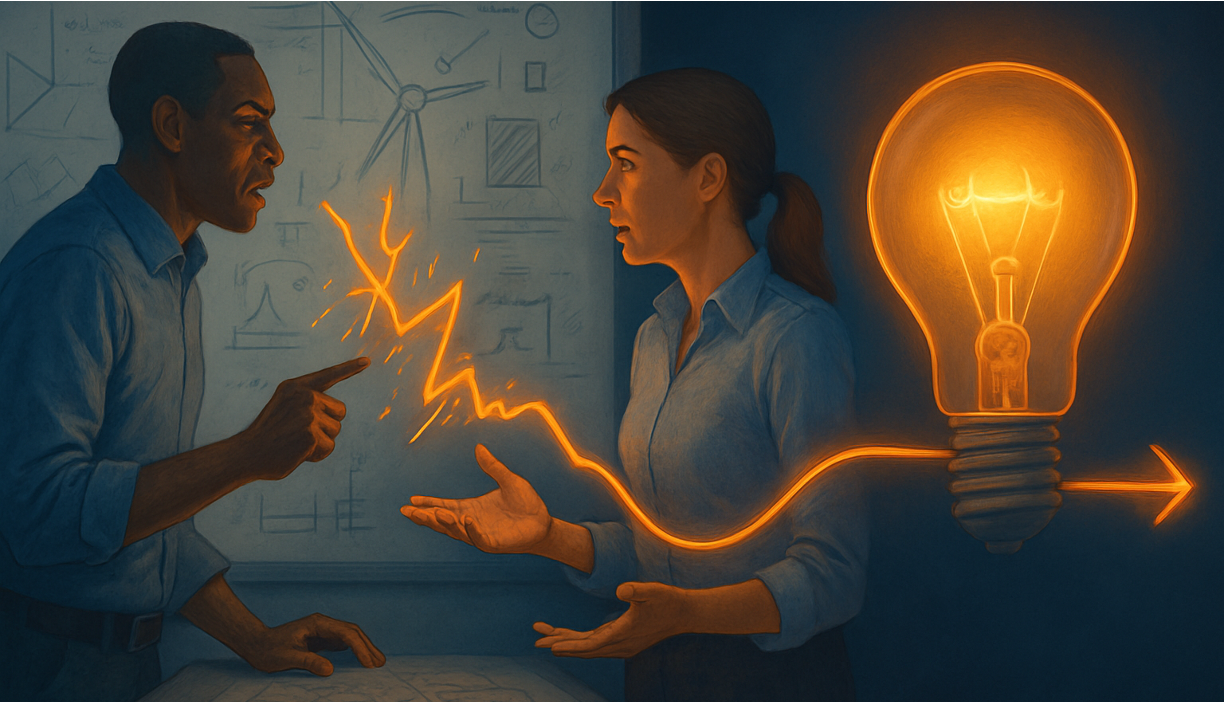
Constructive Tension: The Friction That Sharpens Great Teams
In 1962, during the Cuban Missile Crisis, President John F. Kennedy’s advisors were split—some urged immediate airstrikes on Soviet missile sites in Cuba, others warned it could spark war. Kennedy kept opposing views in the room, pressing for blunt challenge and even having people argue the opposite side to stress-test assumptions.
The sustained, high-stakes debate led to a creative alternative—a naval blockade paired with back-channel diplomacy—that defused the crisis without a shot fired.
That ability to keep disagreement alive without letting it derail the mission is what I call constructive tension—one of the six characteristics of great teams I’ve written about. It’s the discipline of holding competing ideas long enough for something better to emerge, using friction not as a wedge but as a sharpening tool. When it’s present, teams turn conflict into clarity, trust, and stronger decisions.
Why Constructive Tension Matters
When a team can stay in disagreement without breaking apart, the quality of its thinking changes. Assumptions get tested. Blind spots get exposed. Ideas evolve past their first, easy form. Constructive tension changes how teams solve problems in the moment, delivering benefits that compound over time.
Better decisions under pressure. When different perspectives are fully aired, teams make choices with a clearer view of the risks and tradeoffs. A product launch team that debates the timing and pricing from multiple angles is less likely to be blindsided by market reactions.
Fewer blind spots. High-trust challenge surfaces issues early. In a hospital surgical unit, a junior nurse who feels safe pointing out a potential error can prevent a small oversight from becoming a catastrophic mistake.
More creative solutions. Letting opposing ideas coexist forces the brain to connect unlikely dots. In an ad agency pitch, a creative lead and a strategist might argue fiercely over tone and messaging, only to combine their visions into a campaign that resonates far more deeply than either would have alone.
Stronger team confidence. When teams see disagreement lead to better outcomes, they become more willing to speak up next time. A crisis communications group that has worked through tense debates in the past knows they can handle conflict without derailing the mission.
The Competitive Edge of Challenged Thinking
In studying elite teams, whether in national security, elite sports, or high-growth companies, I’ve found that constructive tension is never accidental. It’s cultivated. The Golden State Warriors became a dynasty not just because of their ball movement, but because of their locker-room debates, where veterans and rookies challenged each other’s reads mid-series. The U.S. Women’s National Team built a legacy not by smoothing over differences, but by competing fiercely for spots, clashing on style, and holding each other to a higher standard than any opponent could.
Inside organizations, the same dynamic drives innovation and resilience. Product and engineering teams push and pull over scope and priorities. Marketing and compliance spar over risk. Leaders in crisis management argue over tradeoffs. When those debates happen in the open—and are worked through rather than smoothed over—they sharpen thinking, uncover blind spots, and lead to better outcomes.
Neuroscience backs this up. Sustained disagreement pushes the brain out of autopilot and into the prefrontal cortex, where complex reasoning and creativity live. If the environment feels safe enough to avoid triggering fight-or-flight responses, that extra cognitive load turns into better pattern recognition, sharper judgment, and more original solutions.
The Human Power Behind Constructive Tension
By default, we avoid disagreement. It feels risky. The amygdala reads challenge as potential threat, narrowing attention and prompting us to either push back hard or withdraw. But in the right conditions, those same biological responses can prime us for peak performance. Heightened arousal floods the brain with dopamine and norepinephrine, sharpening focus and increasing the likelihood that new insights will stick.
Four dynamics explain why constructive tension, handled well, is such a powerful force for teams:
We grow through friction. Learning accelerates when the brain experiences prediction error—when something challenges what we believe or expect. The hippocampus activates to rewrite our mental models. Teams that normalize dissent create more of these moments, deepening insight and adaptability.
We strengthen commitment by staying in the arena. People risk speaking up only when they believe it won’t cost them belonging. In high-functioning teams, members engage in difficult conversations because they trust that the relationship—and the mission—can withstand the challenge.
We make better decisions by resisting premature closure. Constructive disagreement disrupts our bias toward ideas that feel easy or familiar, forcing us into deliberate thinking. This reduces groupthink and leads to more robust, resilient decisions.
We clarify priorities by testing boundaries. When tradeoffs emerge, disagreement forces teams to articulate what matters most. These moments reveal the values worth defending and help align decisions with them.
The Anatomy of Constructive Tension
Constructive tension isn’t chaos. It’s a set of patterned behaviors that allow teams to press into differences without splintering. In high-performing groups, it shows up in five ways:
Challenging ideas without attacking people. On a strong team, someone can say, “I think we’re solving the wrong problem” and have it land as contribution, not criticism. The focus stays on the work, not the person, and curiosity replaces defensiveness.
Holding differences long enough to learn from them. Most groups rush to collapse competing views, mistaking speed for efficiency. Great teams let opposing ideas coexist—sometimes for weeks—while they test assumptions and explore possibilities. That space often produces insights that quick agreement would bury.
Signaling connection even in the heat of debate. Disagreements don’t feel like personal attacks because teammates show, through tone, posture, and quick repair, that they remain on the same side. These small cues lower the emotional cost of speaking up.
Framing disagreement as a contribution, not a threat. Teams that thrive on friction share a mental model: challenge strengthens the work. With that story in place, people see their pushback as adding value rather than risking belonging.
Rebuilding alignment once the debate is done. Constructive tension doesn’t mean endless argument. High-performing teams know when it’s time to close the loop. After the hard debates, they commit to the chosen path together, turning friction into sharper execution rather than lingering division.
Sparking New Leadership Thinking
Leaders who want to make constructive tension a team strength have to design for it, model it, and reward it. Five practices stand out:
Name disagreement as a feature. Set the expectation that friction is a driver of excellence, not a sign of dysfunction. Reinforce it in hiring, onboarding, in retrospectives, and in how you respond when it shows up in real time.
Build trust before the high-stakes moments.The more your team knows about each other’s working styles, triggers, and intentions, the easier it is to keep debate from turning personal. Invest in relationships before you need them.
Interrupt false harmony. When consensus comes too easily, pause and invite dissent. Ask, “What’s the strongest counterargument we haven’t explored?” or “If this fails, what will be the reason?”
Create safe containers for challenge. Structured formats like pre-mortems, red teams, or rotating “devil’s advocate” roles normalize pushback and make it part of the process rather than a personal act.
Celebrate the courage to challenge. When dissent sharpens the work, call it out in the moment. Recognizing those contributions reinforces the idea that speaking up is an act of commitment, not disruption.
The Bottom Line
Constructive tension isn’t the opposite of alignment; it’s often the path to it. Teams that can hold competing views without splintering produce sharper ideas, stronger trust, and a greater capacity to adapt. In a world that rewards speed and certainty, it’s the leaders who can keep the hard conversations alive, without breaking the team, that will consistently deliver the most enduring results.
Additional Resources
Here’s some relevant content that you may find interesting:
The Art Of Winning: Lessons From Dominant Sports Teams. This Humanity At Scale article takes a closer look at 10 winning teams—from the All Blacks to the USWNT to UConn basketball—and surface the hidden dynamics that fueled their dominance.
What Can A 17th-Century Shipwreck Teach Us About Groupthink? This Humanity At Scale article looks at a bit of Swedish history to examine how groupthink can smother doubt, bury dissent, and reward comfort over truth.
What If “Culture Fit” Is Holding You Back? This Humanity At Scale article demonstrates that If you want your team to evolve, you need to hire the people who stretch your thinking—not just the ones who feel familiar.
The Snowball Effect. This episode of “The Hidden Brain” podcast is a compelling exploration of how social pressure and the spread of silent assumptions can escalate into destructive consensus—without anyone noticing it unfolding.
Kennedy and the Cuban Missile Crisis. This article in the Foreign Policy Journal describes Kennedy’s use of vigorous debate as a way for everyone to voice ideas, helping the president synthesize a high-stakes policy.
Humanity At Scale: Redefining Leadership Podcast
Available on Apple Podcasts, Spotify, and YouTube.
Make sure to check out my podcast, where I reimagine leadership for today’s dynamic world—proving that true success begins with prioritizing people, including employees, customers, and the communities you serve. From candid conversations with executives to breakthrough insights from experts, Humanity at Scale: Redefining Leadership Podcast is your ultimate guide to leading with purpose and empathy.
Here are some recent episodes:
The Anti-Transactional Venture Capitalist: How You Get More By Giving First. In this episode, Brad Feld, co-founder of Techstars, Foundry Group partner, and pioneer of the “Give First” philosophy explores how generosity, long-term relationships, and emotional self-awareness have shaped Brad’s decades-long impact in venture capital.
Waving the Magic Wand: 14 Leaders Reimagine More Human Organizations. In this special episode, I bring together the voices of 14 past guests, each answering the same powerful question: If you could wave a magic wand, what would you change to make organizations more humanity-centric?
Stars, Stagehands, and Shareholders: Producing Magic on Broadway with Brian Moreland. In this episode, I sit down with Brian A. Moreland, the Tony-nominated Broadway producer behind Othello, The Wiz, and Thoughts of a Colored Man, to uncover what it takes to lead at the intersection of creative excellence, financial risk, and human connection.
Shaping the Human-AI Workforce: Leading with Intention and Eastern Wisdom with Faisal Hoque. In this episode, I sit down with Faisal Hoque, a three-time Wall Street Journal bestselling author and technology leadership visionary. We explore what it truly means to lead in a world increasingly shaped by AI, from managing hybrid teams of humans and machines to navigating the moral dimensions of automation.
Unlocking Digital Transformation: The Neuroscience of Change with Kamales Lardi. In this episode, I sit down with Kamales Lardi and we explore why successful transformation is 80% about people, not technology. Kamales shares how to build digital confidence, foster trust, and use AI to enhance rather than replace human potential.
The podcast is available on Apple Podcasts, Spotify, and YouTube.
Bruce Temkin is a globally recognized thought leader who has spent his career transforming how organizations engage their stakeholders. Known as the “Godfather of Customer Experience,” he has shaped how companies worldwide approach purpose, trust, and empathy. Today he leads the Humanity at Scale movement, empowering leaders to build human-centric organizations that achieve lasting success. He is available for keynote presentations that challenge conventional thinking and inspire leaders to drive meaningful change.