
Could Better Storytelling Transform Your Influence?
Harnessing The Leadership Superpower of Storytelling

Are you losing ground to a better storyteller?
Stories aren’t just for books and movies—they’re the currency of influence in leadership. In every meeting, pitch, or town hall, people aren’t just processing your facts; they’re interpreting your narrative. And here’s the truth: the leaders who know how to shape that narrative win attention, build trust, and move people to action.
This week’s edition of Humanity at Scale unpacks the anatomy of great storytelling—the beats, twists, and emotional hooks that make stories unforgettable. We’ll explore how these classic elements can be used in a business context, why they work on a brain-science level, and how you can start weaving them into the moments that matter most for your team.
In case you missed it, the latest episode of Humanity At Scale: Redefining Leadership Podcast brings together the voices of 14 past guests, each answering the same powerful question: If you could wave a magic wand, what would you change to make organizations more humanity-centric? It’s a fast-moving, thought-provoking episode.
I hope you enjoy this edition. If you do, I’d love for you to subscribe and share it with others who might benefit. Let’s dive in.

Harnessing The Leadership Superpower of Storytelling
Skills and expertise can open doors, but storytelling is what gets people to follow you through them.
After coaching hundreds of professionals at various stages in their careers, one thing has become clear: there’s almost no path to a senior executive role for those who aren’t strong storytellers. Even highly competent individuals often hit a ceiling without this crucial skill.
Storytelling might just be the most valuable tool in your career toolbox—it’s certainly been essential for mine. From my early days designing submarine missile systems (yes, really!) to building multiple global organizations, the ability to craft and deliver compelling narratives has been core to my success.
Think of storytelling as a superpower. It’s the secret weapon that can propel you to new heights and unlock opportunities you never thought possible.
One of my favorite quotes captures this perfectly:
“Thou shalt not is soon forgotten, but once upon a time lasts forever.” —Philip Pullman
The Power of Stories
Storytelling is more than a communication skill—it’s a leadership multiplier. It helps people connect to your ideas, remember your message, and rally behind your vision. In a noisy, complex world, that kind of clarity and connection becomes a superpower that amplifies your influence.
So why do stories work so well?
Stories make data human. Numbers rarely inspire action on their own—but wrap them in a story, and they suddenly become emotional. You can show churn metrics, or you can describe the customer who almost left because nobody followed up after onboarding.
Stories create connection. We’re wired for stories. They tap into emotion, build empathy, and create shared understanding. A story told with vulnerability can build more trust than ten bullet points ever could.
Stories inspire action. Consider Malala Yousafzai. Her story didn’t just raise awareness for girls’ education—it sparked a movement. In business, well-told stories can shift how teams think and spark change at scale.
The Science Behind Storytelling
Stories don’t just feel powerful—they literally reshape how our brains respond to information.
Dopamine enhances focus and memory. Tension and anticipation trigger dopamine, making stories more memorable. Cliffhangers, twists, or even open-ended questions can create this effect.
Cortisol captures attention through stress. Stories that include stakes or challenges activate cortisol, helping us stay engaged and remember the story.
Oxytocin builds empathy. When we hear about someone overcoming adversity, our brains release oxytocin, creating emotional connection and trust.
Neural coupling creates shared understanding. When a story is well told, the speaker and listener’s brains begin to mirror each other—creating a powerful sense of connection and alignment.
The Anatomy of a Good Story
To define what makes a story truly effective—especially in business contexts—I drew from three foundational sources: Freytag’s Pyramid, William Labov’s natural story structure, and modern educational storytelling frameworks. But many of the most effective elements I’ve seen in leadership communication—like the strategic pause or the twist ending—go beyond traditional models.
Here are eight essential elements of stories that work when used in business settings:
A strong opening hook. Business audiences are skeptical and distracted—so stories must earn attention quickly. Start with tension, surprise, or an unresolved question. “What if I told you our biggest growth driver last year came from a mistake?”
A grounded setting. A good story needs a where and when. A hallway conversation at a conference, a tense boardroom meeting, a 2 a.m. message from a customer—these details make the story feel real and concrete.
A central character. Anchor the story in a single person to build emotional connection. Whether it’s a team lead making a tough call or a customer navigating frustration, people remember people—not org charts.
A conflict or challenge. Conflict gives a story purpose. It introduces stakes and forces decisions. Whether it’s a breakdown in trust, a product that failed, or a team that clashed, tension is what keeps the audience engaged.
A clear arc with momentum and resolution. Good stories move. There’s a shift, a turning point, and an outcome. Even small arcs—like realizing a flawed assumption—help the story land.
A deeper meaning or message. Effective stories leave behind more than facts—they reinforce values. Maybe the real message isn’t about budget approval, but about listening better across functions.
A satisfying sense of closure. Closure helps the audience transition from reflection to insight. Even in open-ended situations, there’s value in ending with what’s been learned or decided.
The prestige. Borrowed from stage magic, the prestige is the twist that reshapes the story just when it seems complete. Think of a Bond film: the villain is gone—until he reappears for one final strike. In business, it might sound like, “And here’s the part we didn’t see coming—this feature we almost cut became the customer favorite.” The prestige doesn’t just end the story—it leaves a mark.
My Storytelling Journey
I didn’t start out as a storyteller—I started as an engineer designing submarine missile systems. Back then, storytelling wasn’t even on my radar. That changed during my MBA and GE’s management development program, where I first got formal presentation training—and discovered I was pretty good at it.
I honed the skill further during my 12 years at Forrester Research, crafting research narratives, delivering keynotes, and running workshops. Storytelling helped me build a following, launch Temkin Group, the Customer Experience Professionals Association, and the Qualtrics XM Institute. Why? Because driving change—whether for customers or employees—requires stories that people believe in.
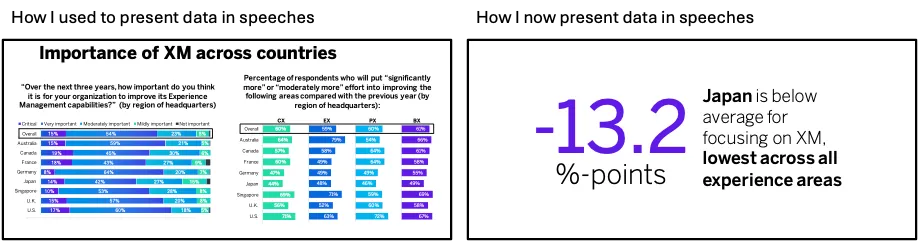
As a simple example of my growth, consider how I once crammed speeches with data—everything I knew. Today, I aim for one powerful story that sticks and moves people.
Ten Ways to Strengthen Your Storytelling
Everyone can become a better storyteller. Here are ten ways to sharpen the skill and make your stories more impactful in business contexts:
Find your story spine. Identify the core message before you start. If you’re trying to shift company culture, the spine might be: “Trust builds speed.” Everything in the story should reinforce that.
Start with a hook. Use a sharp insight, surprising stat, or personal moment to grab attention. “We thought we had a retention problem—but it turned out to be an onboarding problem.”
Create a compelling arc. Even simple stories benefit from structure. Introduce tension, build momentum, and land with clarity. A three-minute story with movement is more powerful than a ten-minute ramble.
Use data as your supporting cast. Let data deepen the story—not dominate it. “Net Promoter Scores dropped 14 points—right after we changed our billing policy” says more when paired with a customer quote.
Be authentic. Vulnerability builds credibility. Sharing a story about a mistake—and what you learned—can have more impact than a flawless success story.
Show, don’t tell. Use vivid language and sensory detail. Instead of “The customer was frustrated,” say, “She stared at the screen, sighed, and said, ‘I’ve tried this three times already.’”
Practice, practice, practice. Great stories are shaped over time. Try them out, get feedback, and refine. Even Steve Jobs rehearsed endlessly for his product launches.
Tailor to your audience. Choose language, tone, and examples that resonate with who you’re speaking to. A frontline team may need empathy; a CFO may need outcomes.
Use metaphor and analogy. Complex ideas stick better when made relatable. “We treated our roadmap like a GPS—focused on efficiency. But what we really needed was a compass.”
Keep it simple. Clarity wins. Avoid jargon and overexplaining. One clean message will be remembered more than five muddled ones.
Sparking New Leadership Thinking
Here are five non-obvious ways leaders can sharpen their storytelling and embed it more deeply into how they lead:
Deconstruct others’ stories to learn structure and rhythm. Don’t just admire a powerful TED Talk or memorable keynote—study it. What was the hook? Where was the tension? How did they land the message? Dissecting others’ stories helps you internalize what works and gives you patterns to model in your own voice.
Use analogies to create clarity during conflict. When tensions run high or teams are stuck, a well-placed metaphor can reframe the moment and lower the temperature. Describing a cross-functional project as “a relay race, not a sprint” or resource decisions as “building the bridge one plank at a time” can shift people from blame to shared problem-solving.
Embed story training in non-obvious places. Don’t confine storytelling to a one-time workshop. Build it into the daily rhythm of the organization. Ask new hires to share a story during onboarding. Invite managers to explain KPIs through real-world examples. Include story segments in quarterly business reviews. Narrative fluency grows when it becomes part of how work gets done.
Practice storytelling in low-stakes, unexpected moments. You don’t need a stage to improve. Use everyday moments—a quick update, a Slack message, a hallway conversation—to share a small story or personal reflection. These informal reps help you build tone, pacing, and trust—all in real time.
Catalog “pocket stories” for repeated use. Great leaders keep a setlist of short, versatile stories they can reach for when needed. Stories that clarify values, humanize strategy, or navigate uncertainty become tools you can use again and again—without sounding rehearsed.
The Bottom Line
If you want to lead change, influence others, or create alignment in a noisy world—storytelling isn’t optional. It’s the connective tissue between data and emotion, insight and action, intent and impact. The best leaders don’t just know how to tell stories—they know which stories need to be told.
Additional Resources
Here’s some relevant content that you may find interesting:
From Homer to GPT: The Collision of Human Imagination and AI. In this episode of Humanity At Scale: Redefining Leadership Podcast, Katherine Elkins, Professor at Kenyon College and Principal Investigator at IBM Notre Dame Tech Ethics Lab, about how AI is transforming human emotion, storytelling, and leadership—from uncovering universal narrative patterns to navigating ethical dilemmas in AI integration.
How Your Brain Responds to Stories—and Why they’re Crucial for Leaders. In this TEDTalk, Karen Eber demystifies what makes for effective storytelling and explains how anyone can harness it to create empathy and inspire action.
Marketing and Freytag’s Pyramid: How to use Story Writing Techniques to communicate your business. Mickey Regala offers a practical guide by showing how to apply Freytag’s five‑stage dramatic arc in marketing contexts. Regala explains each step—exposition through resolution—and why it helps narratives resonate.
Storytelling That Drives Bold Change. This HBR article by Frances Frei and Anne Morriss explains how organizational change is most successful when anchored in a clear, emotionally resonant story constructed around purpose and stakes. It highlights storytelling’s power to unify and mobilize teams.
Invest in the art of storytelling to raise your return on inspiration. In this McKinsey & Company article, Joe Takai and Lisa Hartenberger present research showing that well-crafted, audience‑focused leadership stories significantly improve morale, engagement, and transformation outcomes.
Humanity At Scale: Redefining Leadership Podcast
Make sure to check out my podcast, where I reimagine leadership for today’s dynamic world—proving that true success begins with prioritizing people, including employees, customers, and the communities you serve. From candid conversations with executives to breakthrough insights from experts, Humanity at Scale: Redefining Leadership Podcast is your ultimate guide to leading with purpose and empathy.
The podcast is available on Apple Podcasts, Spotify, and YouTube.
Bruce Temkin is a globally recognized thought leader who has spent his career transforming how organizations engage their stakeholders. Known as the “Godfather of Customer Experience,” he has shaped how companies worldwide approach purpose, trust, and empathy. Today he leads the Humanity at Scale movement, empowering leaders to build human-centric organizations that achieve lasting success. He is available for keynote presentations that challenge conventional thinking and inspire leaders to drive meaningful change.